3 Ways to Get Grease Interceptor Sizing Right
The short of it
- Grease interceptor sizing gives either a flow rating in GPM or a tank volume in gallons; the two never convert.
- A 48 inch by 24 inch by 12 inch sink lands at roughly 44.9 GPM under the Jay R. Smith procedure.
- UPC Table 1014.3.6 runs from 500 gallons at 8 drainage fixture units to 15,000 gallons at 2,640.
- Get the adopted code name, edition year and section number in writing before anyone runs a number.
- Measuring a sink interior is operator work, but opening an in-ground interceptor is permit-required confined-space work.
Grease interceptor sizing gives two different answers for the same kitchen: a flow rating in gallons per minute, or a tank volume in gallons. Which answer applies decides everything downstream.
By the fixture-volume procedure from Jay R. Smith Mfg. Co., a 48 inch by 24 inch by 12 inch sink lands at roughly 44.9 GPM. By Table 1014.3.6 of the 2021 Uniform Plumbing Code, the smallest gravity tank listed is 500 gallons, at 8 drainage fixture units. A GPM rating is not a volume in gallons, and neither converts into the other.
The three ways a grease interceptor size gets set
Three named methods, plus one state amendment, sit behind almost every number a US food service operator is handed, and they take different inputs and return different units.
| Method | What it takes in | What it hands back | Where it is written |
|---|---|---|---|
| Fixture volume | Sink dimensions, 231 cubic inches per gallon, a load factor, a drainage period | A flow rating in GPM | Jay R. Smith data sheet |
| Code flow method | A device tested to a referenced standard, installed per the maker's instructions | Flow-through rating in gpm plus retention capacity in pounds | IPC Section 1003.3.5 (Louisiana 2021) |
| Code volume method | Total drainage fixture units (DFUs) reaching the interceptor | Liquid volume in gallons | UPC Section 1014.3.6 (2021, Hawaii) |
| Meal period headcount | Maximum persons served in the largest meal period | Minimum volume in gallons | Louisiana 1003.2.1, a state amendment |
What governs is the code your jurisdiction adopted, and adopted editions run years behind the model code, so get the code name, edition year and section number in writing first. Silverbeck does not size, sell, install or pump anything; we publish. A call to (800) 555-0184 goes to a partner company working the caller's metro, and the company that answers can measure the fixtures and read a plan review letter with you.
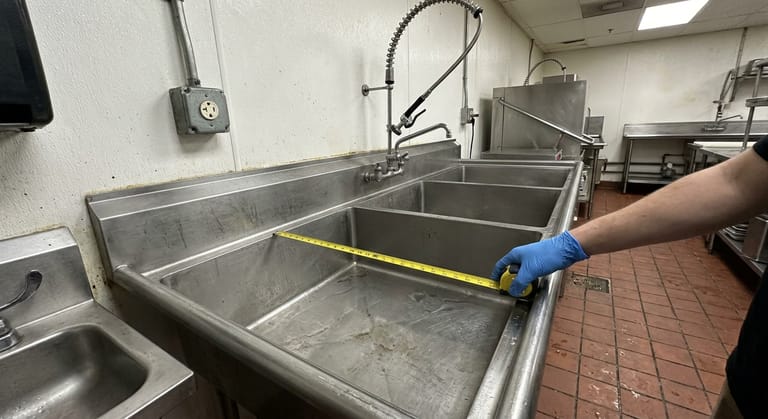
Sizing a grease interceptor from sink dimensions
The point-of-use calculation takes interior sink dimensions, the conversion at 231 cubic inches per gallon, a factor for how full the sink actually drains, and a drainage period. The Smith worked example runs like this:
- Measure the interior of the compartment. A 48 inch by 24 inch by 12 inch sink holds 13,824 cubic inches.
- Convert at 231 cubic inches per gallon. That is 59.8 gallons brim full.
- Apply the actual drainage load. Smith uses 75 percent, because the sink never drains completely full: 59.8 gallons x 75% = 44.9 gallons.
- Divide by the drainage period. Over one minute, roughly 44.9 GPM. Over two minutes, the same sink needs roughly 22.4 GPM.
The 75 percent factor is one manufacturer's assumption, and the result sizes a hydromechanical unit near the fixture, not an in-ground tank. See interceptor versus trap.
Gravity grease interceptor sizing under the UPC
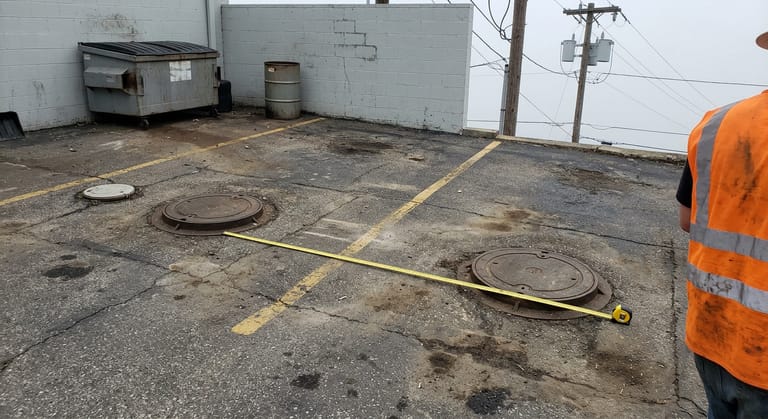
The UPC never asks about sink dimensions. It asks how many drainage fixture units land in the tank, and Section 1014.3.6 sends that count straight into Table 1014.3.6. When nobody has a DFU total, the code accepts a substitute: size the tank for the maximum DFUs the inlet pipe size is permitted to carry. In a kitchen remodeled twice by two different contractors, that pipe is often the only honest record left of what drains where, which is why the fallback exists at all.
Some equipment carries no DFU value. For those connections, Section 1014.3.6 sizes the added volume from what the appliance actually discharges, "the known flow rate (gpm) multiplied by 30 minutes", and that half hour is the retention time the whole table rests on. Everything arriving has to sit still long enough for grease to float and solids to settle before the water leaves.
The gravity grease interceptor sizes in that table run from 500 to 15,000 gallons:
| Total DFUs to the interceptor | Liquid volume (gallons) |
|---|---|
| 8 | 500 |
| 21 | 750 |
| 35 | 1,000 |
| 90 | 1,250 |
| 172 | 1,500 |
| 216 | 2,000 |
| 307 | 2,500 |
| 342 | 3,000 |
| 428 | 4,000 |
| 576 | 5,000 |
| 720 | 7,500 |
| 2,112 | 10,000 |
| 2,640 | 15,000 |
Those rows are UpCodes rendering the same table in the Hawaii Plumbing Code 2021; check the printed table in your adopted edition. It indexes volume, not material, so concrete and plastic tanks of equal capacity land on the same row, while Section 1014.3.3 governs construction. More on the gravity interceptor page.
What the IPC does with flow instead of volume
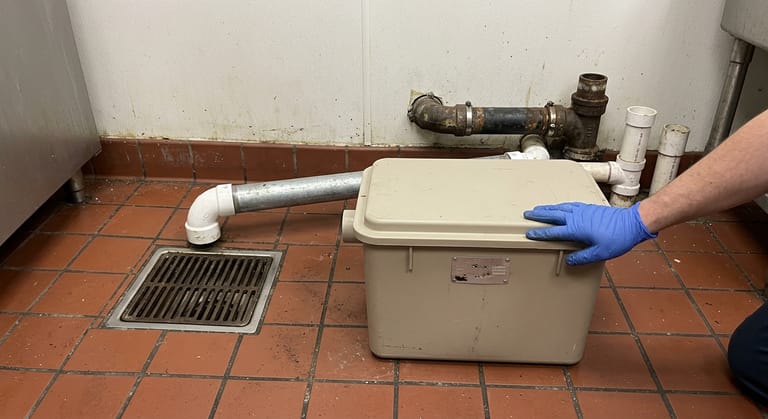
The IPC starts at the equipment. Section 1003.3.1 puts an interceptor or an automatic grease removal device on anything discharging grease-laden waste in a food preparation area, then names what it means. The Maryland plumbing code of 2024 opens the list with "pot sinks, prerinse sinks; soup kettles or similar devices; wok stations" and carries on through floor drains and sinks that kettles are emptied into, automatic hood wash units, and dishwashers running without a prerinse sink ahead of them. Treat that as an inventory exercise on the floor: each of those connections is a sizing input, and one wok station nobody wrote down moves the answer.
Sizing itself is delegated to standards. Section 1003.3.5, in the 2021 edition as adopted in Louisiana, takes a device tested to PDI-G101, to CSA B481.3, or to one of three ASME standards: A112.14.3, A112.14.4 and A112.14.6. The unit then has to go in the way its manufacturer's instructions specify, which is where a field improvisation quietly costs you the rating you paid for.
Capacities live in Table 1003.3.5.1 in IPC 2021. Each row carries two numbers side by side: a total flow-through rating in gpm, and the pounds of grease the unit is rated to hold. The 25 gpm row sits with 50 pounds. Full set: hydromechanical ratings.
What PDI-G101 and the ASME standards do
PDI-G101, "Testing and Rating Procedure for Grease Interceptors," revised 2017, has units tested in independent laboratories and then rated, with a certificate issued for each interceptor tested. The standard is voluntary; its force comes from the code adopting it. ASME A112.14.6 covers FOG disposal systems, a device class that must also internally dispose of what it retains.
Talk to someone who opens these lids every week
Call (800) 555-0184Free to dial. Whoever answers pumps and services grease interceptors; ask for the registration number your city requires while you are on the call.Partner haulers and plumbers who work on food service drains- Partners who pump interceptors, not just unclog sinks
- Answered during the dinner rush
- Dialing costs nothing and books nothing
Sizing grease interceptor volume by meals served
The headcount method survives in state amendments. Louisiana rewrites IPC Section 1003.2.1 so the trigger is the dining room rather than the drain line: minimum required capacity is "determined based upon the maximum number of persons served during the largest meal period". Three numbers bound the result. Nothing may hold less than 125 gallons below the static water level. Past 50 persons served, at least 2 1/2 gallons per person gets added. And no unit may be installed with an approved rate of flow under 20 gallons per minute. A 180 seat operation running one heavy dinner service therefore prices out very differently from a 180 seat cafe spreading the same count across a whole day.
What the manufacturers add
What a specific establishment ends up needing is worked through on restaurant grease interceptors. Manufacturers argue for a third input entirely: grease produced, not water moved. Schier builds that into its Grease Production Sizing Method, which in the company's own words estimates "how much grease a restaurant is likely to produce" so the tank still has room at the end of a realistic pumpout interval. Weigh it as a vendor position, argued against the code methods by a company that sells the tanks.
The formula is not public; it sits behind the Grease Monkey sizing app and an ebook. Schier's sizing page lists no gallon or gpm figures against designations such as GB-50, GB-250 and GB-1000, so take capacities from the product spec sheets rather than from the suffix. See the Schier line overview.
Why a bigger tank is not automatically the right answer
UPC Section 1014.3.4 requires the unit to stay accessible for inspection and cleaning, reachable by maintenance equipment and close to the fixtures it serves. A bigger tank in the far corner of the lot can satisfy the table and fail that.
Capacity does not excuse maintenance. A tank that never fills still gets pumped on whatever schedule the local FOG program sets, and grease interceptor sizing has no effect on that calendar. How often the unit gets cleaned is where the operating burden sits.
When the city sends back a size you cannot reproduce
The usual version: a plan reviewer returns a required capacity, say 1,500 gallons, or calls an existing 50 GPM unit undersized, citing a section number with no worksheet. Check three things before you argue.
- Which code and edition. Table 1003.3.4.1 and Table 1003.3.5.1 are the same capacity table in different IPC editions.
- Which unit the answer is in, because gallons of volume and a gpm rating are not convertible.
- Whether a state or local amendment applies, like the Louisiana meal-period rule.
If your arithmetic reproduces the reviewer's number, buy the unit the table points to. If not, bring the letter, the code edition and your fixture list to that call, because grease interceptor sizing arguments end fastest when both sides hold the same inputs.
Talk to someone who opens these lids every week
Call (800) 555-0184Free to dial. Whoever answers pumps and services grease interceptors; ask for the registration number your city requires while you are on the call.Partner haulers and plumbers who work on food service drains- Partners who pump interceptors, not just unclog sinks
- Answered during the dinner rush
- Dialing costs nothing and books nothing