What a Grease Interceptor Is and Its 3 Types
The short of it
- One tank does the job: it holds kitchen wastewater until grease floats, solids settle, and clear water leaves.
- IPC Section 1003.3.1 hangs the requirement on the fixture, not the business type: grease-laden waste draining in a food preparation area is the trigger.
- Three families: hydromechanical units rated in GPM, buried gravity tanks rated in gallons, and automatic grease removal devices.
- You can trace the pot sink line and read an indoor nameplate; identifying the unit never needs a buried lid off.
- Trap and interceptor name the same machine in code text, so an invoice word does not identify the unit.
A grease interceptor is a tank that holds kitchen wastewater long enough for grease to float, solids to settle, and the clear water between to leave. IPC Section 1003.3.1 hangs the rule on the fixture, not the sign over the door: equipment draining grease-laden waste in a food preparation area.
How the grease interceptor works, layer by layer
Grease floats, food solids sink, and the tank is built around that. Waste enters below the water line so it does not stir the separated layers, and an inlet baffle kills its velocity.
| Part | What collects there | Why it matters |
|---|---|---|
| Inlet baffle | incoming flow | separation replaces pass-through |
| Grease cap | floating fats and oils | measured first at service |
| Middle band | mostly water | the only zone the outlet draws |
| Sludge | settled solids | steals volume; skimming leaves it |
| Outlet tee | nothing, by design | if broken, the cap carries over |
The gravity sizing table in UPC 1014.3.6 assumes a 30-minute retention time, so an undersized tank fails even when pumped on schedule: water leaves before the grease climbs. Two piping rules travel with it. IPC Section 1003.9 bars an air-bound design and requires venting per Chapter 9, and Section 1003.10 adds a two-way cleanout immediately downstream of every interceptor, quoted in full on the installation requirements page.
Three machines, three standards, one job
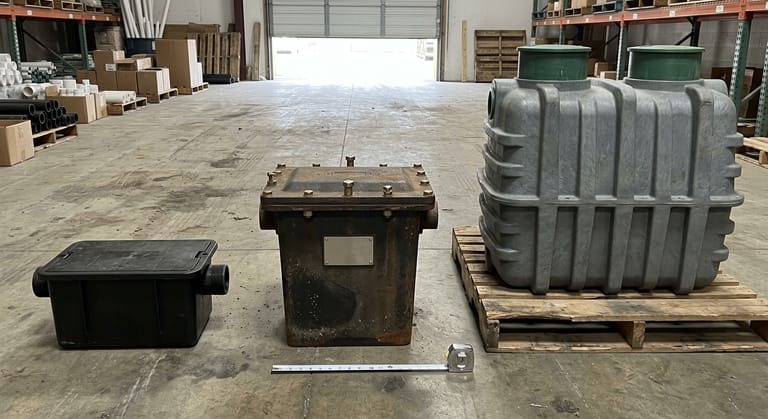
| Family | Where it sits | Rated in | Standards |
|---|---|---|---|
| Hydromechanical | at or near the fixture, indoors | flow in GPM, capacity in pounds | ASME A112.14.3/CSA B481.1 (2022, Dec 2022 errata); PDI-G101 (2017) |
| Gravity, in ground | buried outside, on the outgoing building line | liquid volume in gallons | UPC 1014.3; per 1014.3.3, the Chapter 17 standard or a design the AHJ approves |
| Automatic grease removal device | downstream of the fixture, per the manufacturer | by function, not tank size | IPC 1003.3.5 standards, ASME A112.14.4 among them; per the manufacturer's instructions |
For sizing, IPC Section 1003.3.5 (2021 edition) points to ASME A112.14.3, A112.14.4, A112.14.6, CSA B481.3 or PDI-G101. PDI-G101 is a testing and rating procedure by its title: a unit is assigned a rating rather than passed or failed, certified products carry the Plumbing & Drainage Institute seal, and it binds only where a code adopts it.
One class in that subsection earns no row above: the FOG disposal system. ASME A112.14.6 gives it three duties: "remove FOG from effluent", "retain separated FOG", then "internally dispose retained FOG", cutting the mass and volume it holds by the methods para 4.3.2 sets out. That last duty divides the field: the other two families only store what they separate until a hauler takes it away. IPC 1003.3.6 puts the automatic device downstream of the fixture or fixtures it serves, placement left to the manufacturer's instructions, quoted on the hydromechanical page.
Plastic grease interceptor, steel or cast iron: what the material changes
Less than the catalog suggests. A plastic shell, a steel one, a cast iron body under a sink and a custom tank can all be legal, none of them because of the material. For buried units the UPC points at the Chapter 17 standard or a design approved by the authority having jurisdiction, the path a custom build takes.
Who needs a kitchen grease interceptor, and who writes the rule
Section 1003.3.1, as adopted in the Maryland Board of Plumbing's 2024 code, is one clause: "A grease interceptor or automatic grease removal device shall be required to receive the drainage from fixtures and equipment with grease-laden waste located in food preparation areas". The rest is illustration.
The list that follows opens with "such as": hotel kitchens, hospitals, school kitchens, bars, factory cafeterias, clubs and restaurants. Examples, not limits: a commissary or a church hall qualifies once its fixtures do, and a labeled business that cooks nothing does not.
The fixture list is the usable answer: "pot sinks, prerinse sinks; soup kettles or similar devices; wok stations", then floor drains and sinks that catch drained kettles, automatic hood wash units, and dishwashers at sites with no prerinse sink. Note that last one: a dishwasher counts only where no prerinse sink exists.
Two nearby subsections trip people up: 1003.3.2 bars a food waste disposer from discharging into the tank, and 1003.3.3, as adopted in the Louisiana Plumbing Code 2021, prohibits systems discharging emulsifiers, chemicals or enzymes into it while permitting microbial systems that enhance aerobic bioremediation. The next subsection holds the one exemption: individual dwelling units and private living quarters.
The federal rule reaches you sideways. Grease never appears in 40 CFR 403.5(b)(3). It forbids "Solid or viscous pollutants in amounts which will cause obstruction to the flow in the POTW", with Interference, as the rule defines that term, named as the result. Your numbers come from 403.5(c)(1), where a POTW running a pretreatment program sets specific limits that 403.5(d) then gives the standing of Pretreatment Standards.
Talk to someone who opens these lids every week
Call (800) 555-0184Free to dial. Whoever answers pumps and services grease interceptors; ask for the registration number your city requires while you are on the call.Partner haulers and plumbers who work on food service drains- Partners who pump interceptors, not just unclog sinks
- Answered during the dinner rush
- Dialing costs nothing and books nothing
Interceptor grease trap, in any word order: one box
Invoices and search boxes scramble the words; interceptor grease trap, grease trap interceptor and every other order name one machine. In American shop talk, "trap" is the small unit near the fixture and "interceptor" the buried tank outside, but code text uses interceptor for both. Location and nameplate tell you what you have.
Grease interceptor pump: a product, not a visit
Two things share the phrase: hardware, a unit sold with a pump that moves effluent or skims, and the visit that empties a full tank, a truck, a hose, a signed manifest. Pumping is the service; the pump is a part.
Two minutes to find out which unit is on your site
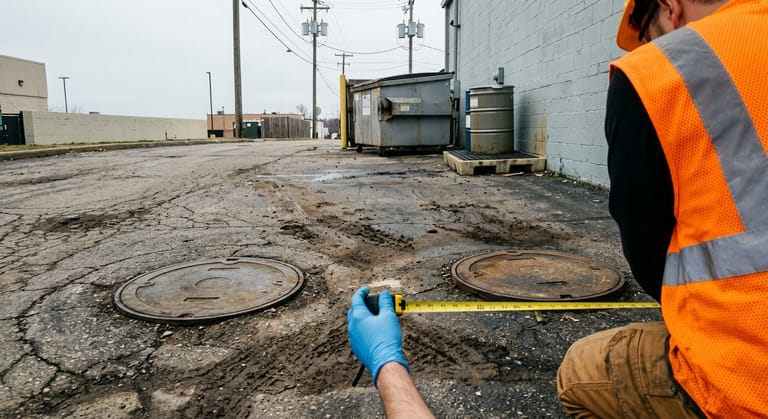
Inherited a kitchen? Settle it without lifting a lid.
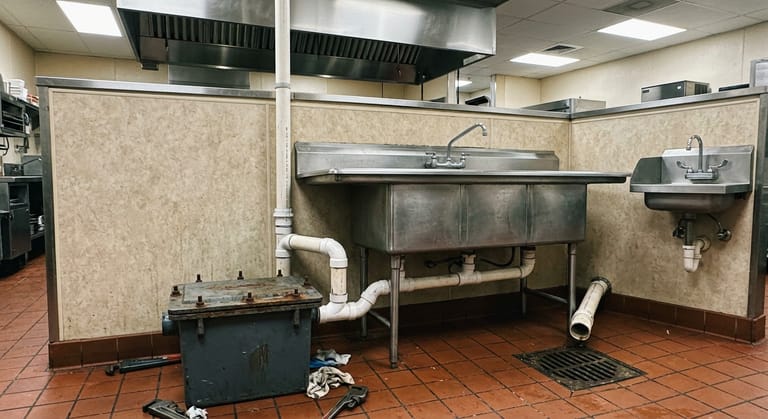
- Start at the pot sink. Follow the waste line: a box beside the cabinet is point of use, a line through the wall puts the tank outside.
- Read the nameplate. The certified series pairs flow with capacity: 4 GPM with 8 pounds, 10 with 20, 25 with 50, 50 with 100, per Jay R. Smith Mfg. Co. data.
- Look for a flow control fitting. Older IPC editions (Section 1003.3.4.2, Alabama Plumbing Code 2009) require a device that keeps flow from exceeding the rating.
- Outside, count lids. Two or three covers in a line usually mean a multi-chamber tank. UPC 1014.3.4 wants it easily reachable for inspection and cleaning, wording quoted on the installation requirements page.
- Find the last pump-out paperwork. Kaufman, Texas requires a manifest kept by generator and hauler for every pump-out; Greensboro, North Carolina takes cleanout reports electronically.
A hauler measures cap and sludge as a share of depth; the trigger number is local. Bloomington, Indiana caps the gap between services at 90 days, then pulls that date forward once waste occupies 25% of the wetted depth, measured from the static water level to the tank bottom. No national figure overrides a local ordinance.
Identification does not need a buried lid off. Never lean over an open tank, climb in or reach inside. A buried unit is confined space: measuring and evacuating it is equipped work for a hauler.
Found a rating plate, a receipt inside your city's interval, and nothing backing up at the floor sink? No call today: file the receipt and check how often the job has to happen. Call when the answers run out, no manifest, a lid nobody can lift, a slow floor sink. Silverbeck publishes and does not pump, clean, install or inspect; (800) 555-0184 reaches a partner company in the caller's area, and a hauler who hears the type, rating and last service date can quote an evacuation.
A visit is priced on volume pumped, hose distance and disposal, so another kitchen's price tells you little. What cleaning costs, broken into parts shows what moves it.
Next, if you are still identifying the equipment
Two names, one function. Interceptor or trap, side by side.
The restaurant case. A kitchen, a bar and a bakery load one machine differently: what restaurants run.
Indoor units. Hydromechanical units in detail: GPM ratings, flow control fittings, certification stamps.
The buried tank. In-ground gravity tanks: UPC 1014.3, construction, truck access, the fixture unit sizing table.
The smallest class. One sink, one cabinet: under-sink units.
Next, if you are specifying, buying or installing
Getting the size right. UPC 1014.3.6 works from drainage fixture units, adding volume for fixtures without a DFU value at flow rate times 30 minutes: how sizing is calculated.
What the permit asks for. Venting, the cleanout, equipment access, which fixtures may connect: installation requirements.
The job itself. Excavation and tie-in versus swapping a box under a sink: how installation runs.
Who makes them. A model number is not a capacity: who builds this equipment, by material, warranty and rating.
One manufacturer. Schier promotes a Grease Production Sizing Method, its estimate of what a restaurant puts out; the Schier line weighs it against the code.
Talk to someone who opens these lids every week
Call (800) 555-0184Free to dial. Whoever answers pumps and services grease interceptors; ask for the registration number your city requires while you are on the call.Partner haulers and plumbers who work on food service drains- Partners who pump interceptors, not just unclog sinks
- Answered during the dinner rush
- Dialing costs nothing and books nothing