Restaurant Plumbing Rules 2 Inspectors Check First
The short of it
- Restaurant plumbing answers to two rulebooks at once, the plumbing code your state adopted and the FDA Food Code 2022.
- Food storage, preparation and handling equipment needs the air gap under IPC 802.1.1; dish machines and warewashing sinks may use either.
- Hand sinks need water at least 85 degrees F under Food Code 5-202.12(A), and metering faucets at least 15 seconds.
- No grease trap requirement comes from the Food Code; IPC 1003.3.1 triggers it for grease-laden waste in food preparation areas.
- Clearing hand sinks and checking tailpieces needs no visit; code corrections go to a plumber, pumping to a registered hauler.
Restaurant plumbing is judged by two rulebooks at once: the plumbing code decides how every drain connects, and the FDA Food Code 2022 decides whether the sinks pass a health inspection.
The rule to check first is the indirect waste connection: air gap or air break. Silverbeck publishes and does not do the work, so calling (800) 555-0184 reaches an independent partner working kitchens in that area.
The two rulebooks behind commercial kitchen plumbing
No document called the restaurant plumbing code exists. At Section 5-202.11, marked P for Priority, the FDA Food Code 2022 hands the system to state statute: a plumbing system is to be "designed, constructed, and installed according to LAW." LAW means the statutes the jurisdiction adopted, so the sections behind one prep sink change at a state line.
In most states that law is a version of the International Plumbing Code. Section 802.1, as adopted in the Delaware Plumbing Code, keeps food-handling equipment, dishwashing machines and warewashing sinks, in other than dwelling units, off a direct connection to the sanitary drainage system. Commercial kitchen plumbing requirements are local, and section numbers move between editions.
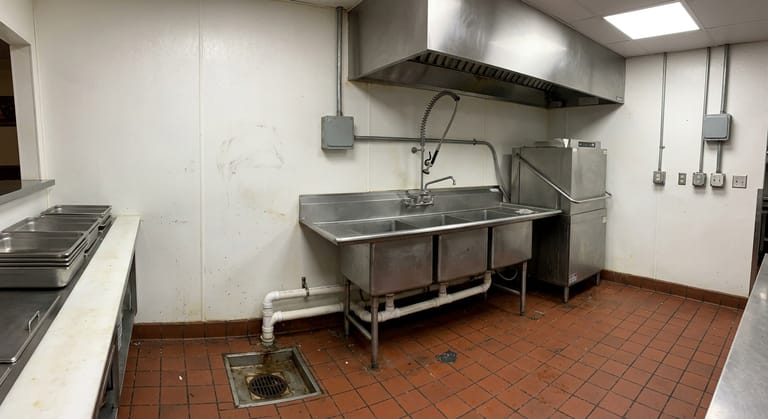
The plumbing a restaurant operator inherits with the lease
A lease hands over pipe approved for the previous tenant's menu, and a coffee bar now running fryers has changed what its fixtures produce.
The interceptor trigger sits in the plumbing code, not the Food Code. Section 1003.3.1, as adopted in the Maryland Plumbing Code 2024, calls for an interceptor or automatic grease removal device wherever fixtures and equipment produce "grease-laden waste located in food preparation areas." Restaurants, hotel kitchens, hospitals, school kitchens, bars, factory cafeterias and clubs follow as examples, not as the limit, so a dessert counter with one fryer meets the same test. Device families sit on the grease interceptor hub, the arithmetic on interceptor sizing, the kitchen view on restaurant grease interceptors.
Air gap or air break, the line inspectors check first
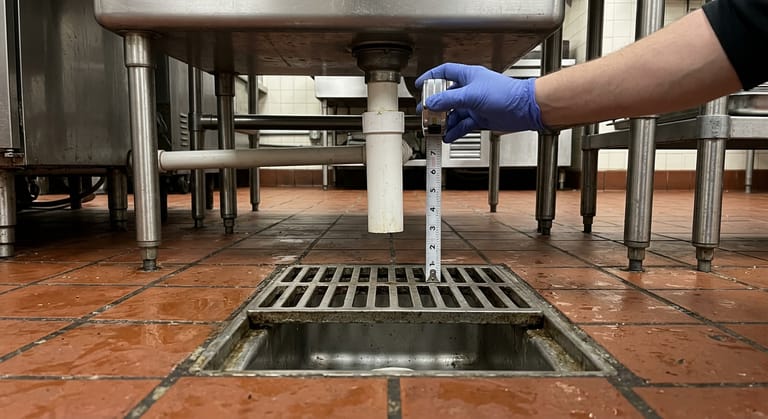
An air gap is open air between the pipe end and the flood level rim below it; an air break ends under that rim but above the trap seal (802.3.2).
Where food is stored, prepared or handled, Section 802.1.1 allows one termination, "an indirect waste pipe by means of an air gap," so the prep sink tailpiece and the ice machine line stop above a floor sink, never in it. Section 802.3.1 sets the gap at twice the effective opening of the waste pipe: a 1 inch line wants 2 inches of air under it. A rubber boot pushed over the grate removes the gap.
A commercial dishwashing machine drain may take either termination (802.1.6), and so may utensil, pot and pan washing sinks (802.1.7).
Floor sinks, standpipes and restaurant sink drains
The receptor is whatever catches the indirect line: a floor sink, a hub drain, a standpipe. Floor sinks are the usual pick. Height is where standpipes fail: Section 802.4.3 gives a window, "not less than 18 inches (457 mm) but not greater than 42 inches (1067 mm) above the trap weir," and a drain hose zip-tied to a shelf leg sits outside it. Commercial kitchen sink plumbing at a three-compartment sink still ends over a receptor, not in a wye behind the wall.
Handwashing sinks are a Food Code fixture first
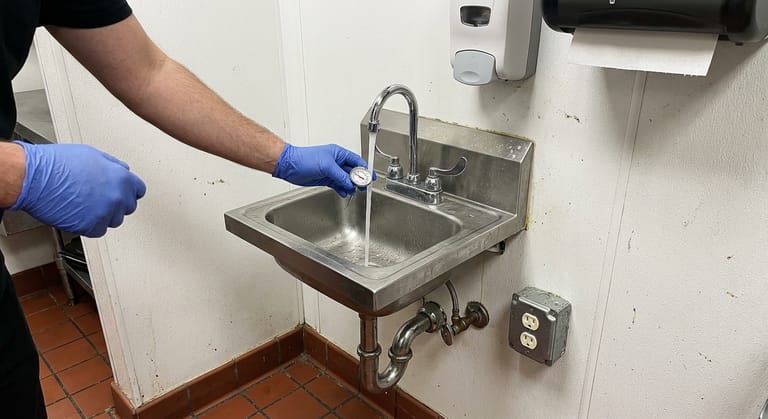
A blocked hand sink is a common write-up. Section 5-203.11 requires at least one, plus the number employees need for convenient use; 5-204.11 puts them in food preparation, dispensing and warewashing areas and next to toilet rooms.
The 2022 edition puts the floor at 85 degrees F (29.4 degrees C) in 5-202.12(A), tempered at the fixture by a combination faucet or a mixing valve. Older editions carried 100 degrees F, so a state on an older adoption enforces the higher figure. Paragraph (C) adds a second test: a metering, self-closing or slow-closing faucet has to keep water moving for 15 seconds on one activation. Section 5-205.11 governs use, and a bus tub parked in the hand sink is a Priority foundation violation.
Talk to someone who opens these lids every week
Call (800) 555-0184Free to dial. Whoever answers pumps and services grease interceptors; ask for the registration number your city requires while you are on the call.Partner haulers and plumbers who work on food service drains- Partners who pump interceptors, not just unclog sinks
- Answered during the dinner rush
- Dialing costs nothing and books nothing
Backflow protection for kitchen equipment
IPC Section 608.1 keeps nonpotable liquids, solids and gases out of the potable supply (Delaware, Chapter 6), and 608.17 names the kitchen equipment: a carbonated beverage dispenser takes an ASSE 1022 backflow preventer or an air gap (608.17.1.1), coffee machines and other noncarbonated dispensers a device to ASSE 1022, ASSE 1024 or ASSE 1032, or an air gap (608.17.1.2).
The Food Code adds a supply air gap at least twice the inlet diameter and never under 1 inch (5-202.13), devices reachable for service (5-204.12), and records kept by the person in charge (5-205.13).
What a commercial kitchen plumbing diagram should show
A usable restaurant kitchen plumbing layout marks, for every restaurant plumbing fixture:
- the receptor each indirect line drains into, and whether it ends as a gap or a break
- hand sink positions relative to food preparation, dispensing and warewashing areas
- which fixtures carry grease-laden waste, and the food waste disposer that may not, per Section 1003.3.2: "A food waste disposer shall not discharge to a grease interceptor." (Louisiana Plumbing Code 2021), with the rest under installation requirements
Health inspector or plumbing inspector, who checks what
The plumbing inspector signs off at rough-in and final, so one restaurant fixture can pass that visit and fail a health inspection months later.
| In the kitchen | Health inspector (Food Code 2022) | Plumbing inspector (IPC) |
|---|---|---|
| Hand sink at prep line | Convenient use (5-204.11); handwashing only (5-205.11) | Fixture, trap, waste connection |
| Prep sink, ice machine | No direct connection to sewage (5-402.11) | Indirect waste, air gap (802.1.1) |
| Carbonator, coffee brewer | Approved device, records (5-202.14, 5-205.13) | ASSE device or air gap (608.17.1.1, 608.17.1.2) |
| Grease interceptor | Access clear, no Priority mark (5-402.12) | Required for grease-laden waste (1003.3.1) |
Failed an inspection? The order to fix restaurant plumbing write-ups
Reports list items in the order the inspector walked, not the order that closes fastest.
- Clear the hand sinks. 5-205.11 wants them accessible at all times and used for nothing else.
- Look under every sink with a flashlight. Each tailpiece either ends in open air above the receptor rim, or it has been shoved into the pipe.
- Run the hand sink and time the faucet. Water under 85 degrees F, or a metering faucet short of 15 seconds, points at the mixing valve.
- Split licensed work out of housekeeping. Re-piping, a new floor sink, a corrected direct connection and a backflow device need a licensed trade; a slow line is a cleaning question first, see restaurant drain cleaning.
When a restaurant plumbing service is worth the call
The first three steps need no visit. The fourth is licensed work, and the sooner a restaurant plumbing service is booked the less of it lands in service hours. Have the inspection report and the dish machine model ready.
Do restaurant plumbing services cover drains and interceptors too?
The trades usually split: code corrections and fixture work go to a licensed plumber, pumping to a hauler registered with the municipality or the sewer authority. If the report names the interceptor, start with grease trap cleaning and the schedule in how often to clean a grease trap.
Talk to someone who opens these lids every week
Call (800) 555-0184Free to dial. Whoever answers pumps and services grease interceptors; ask for the registration number your city requires while you are on the call.Partner haulers and plumbers who work on food service drains- Partners who pump interceptors, not just unclog sinks
- Answered during the dinner rush
- Dialing costs nothing and books nothing