Restaurant Drain Cleaning, 2 Checks Before Calling
The short of it
- Three faults cause a restaurant drain backup: a local clog at one fixture, a full grease interceptor, or a blocked lateral.
- The floor sink under the dish table floods first because water leaves at the lowest opening on the line.
- Flush a restroom or bar sink that does not share the kitchen line; if it backs up too, cabling opens nothing.
- A plumber clears pipe, a hauler empties the tank, so the fault you found decides which one to call.
- Portland BES says most interceptors need cleaning at 25 percent full of FOG and solids; other cities set that trigger their own way.
Restaurant drain cleaning starts with finding which of 3 faults caused the backup: a local clog at one fixture, a full grease interceptor, or a blocked building lateral. Two checks tell them apart in two minutes, and drain cleaning on the kitchen branch opens nothing when the restriction sits past the building wall.
Silverbeck publishes and runs no trucks. Calling (800) 555-0184 reaches an independent partner service company, which sends the plumber or the hauler the fault calls for.
How a grease blockage builds in a commercial kitchen
Hot water off a range or a dish machine carries fats, oils and grease down the drain in suspension. A few yards later that water has cooled, the FOG drops out against the pipe wall and hardens. Every service adds another film until the bore closes.
Detergent is why it gets missed. The sink looks clear at close, but emulsified grease travels and then settles further down the line. Cleaners, solvents, caustics and chemical emulsifiers all draw the same verdict in the Bureau of Environmental Services guidance on grease interceptors from Portland, Oregon: they "do not eliminate FOG." A kitchen that scrubs hard nightly still builds the blockage.
Where the blockage shows first
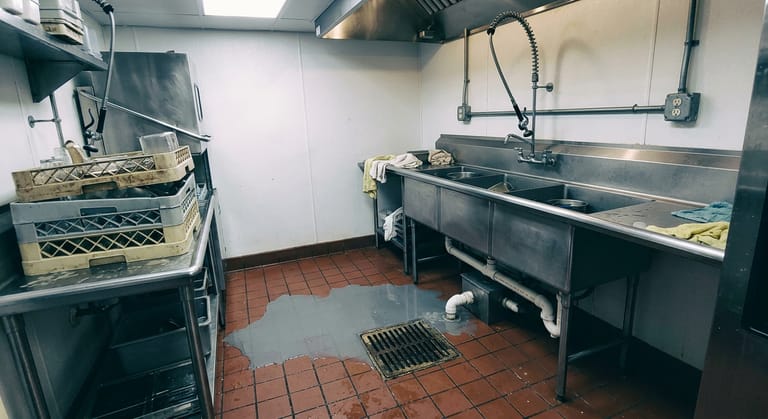
Water leaves at the lowest opening, usually the floor sink under the dish table, while fixtures above it drain normally.
That floor sink exists because of code. Under IPC 2021 Section 802.1.1, in Chapter 8 on indirect and special waste, gear that stores, prepares or handles food reaches the drainage system indirectly, "by means of an air gap." That gap is open air above the receptor, so nothing on the sewer side climbs back into a prep sink. The dish machine and warewashing sinks land in the same kind of receptor under 802.1.6 and 802.1.7, which also allow an air break.
The puddle is the trade-off: a restricted branch has an exit at floor level and takes it. So the flooded floor sink is evidence, not the fault: the blockage sits below it.
Local clog, full interceptor, or lateral
| What you see | Most likely cause | The check that confirms it |
|---|---|---|
| One fixture slow, the rest fine | Local clog in that trap or branch | Run a neighboring fixture; if it drains, the restriction is above the shared line |
| Kitchen fixtures slow together, floor sink surging first | Interceptor full, or its outlet restricted | Measured accumulation by a hauler, not a glance under the lid |
| Kitchen and restrooms both backing up | Building lateral, or the sewer beyond | Kitchen shut off, and the lowest drain still holds water |
A look under the lid settles nothing; measurement does: grease cap on top, sludge on the bottom, the two together as a share of liquid depth, read by a hauler. Portland BES says most interceptors need cleaning when they become "25 percent full of FOG and solids." Past that point the tank stops holding waste long enough to separate it, so grease leaves with the outflow and the next fault is pipe, not tank. Other programs write that trigger differently, the subject of how often a grease trap needs cleaning.
Talk to someone who opens these lids every week
Call (800) 555-0184Free to dial. Whoever answers pumps and services grease interceptors; ask for the registration number your city requires while you are on the call.Partner haulers and plumbers who work on food service drains- Partners who pump interceptors, not just unclog sinks
- Answered during the dinner rush
- Dialing costs nothing and books nothing
What commercial restaurant drain cleaning covers
| Cabling | Jetting | |
|---|---|---|
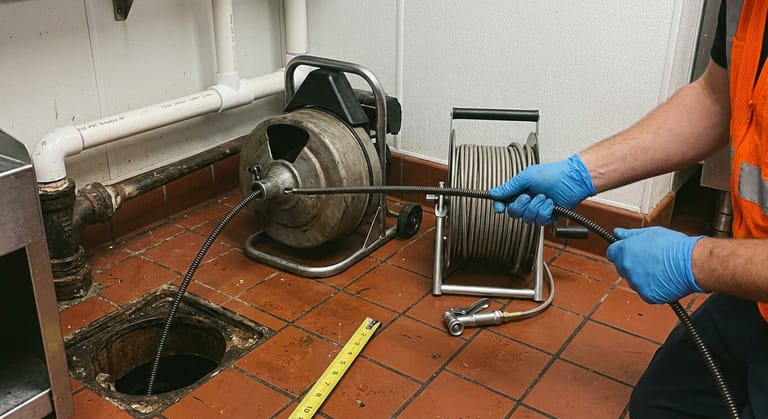
| What it does | Cuts a channel through the blockage | Scours the wall back toward full bore |
| Best against | A hard plug, rags, solids | Congealed FOG film, repeat slowdowns |
| Leaves behind | Grease still on the wall | Little, over the whole run |
Most restaurant drain cleaning calls end in a cleared branch, a pumped tank, or a camera run down the lateral. Neither tool empties a tank, so when the interceptor closed the line the job is grease trap cleaning, with its own paperwork.
What must never go down a kitchen drain
Two things never go down a kitchen drain under these programs. Anything a hauler pumps out of the interceptor: Windsor Heights, Iowa, in section 100.62, sends that load to a water reclamation facility or another approved facility, never to a private or city sewer, the record side of grease trap pumping. And additives dosed to dissolve grease: Portland, Oregon prohibits them in grease interceptors under Administrative Rule ENB-4.26.
Grease is not named in 40 CFR 403.5(b)(3). The federal ban reaches "Solid or viscous pollutants," and only where the amount blocks flow at the treatment works and that blockage causes Interference, a term the rule defines. Two conditions, not one, so a slow floor sink is not a federal case. The numbers an operator gets cited under are municipal, written under Section 403.5(c)(1).
A floor drain flooding on a Friday night
- Stop the dish machine and the pre-rinse, keep that branch idle two minutes, and watch the level. A slow drop means a restricted line that still moves; no movement means a hard block.
- Test the other side of the building. Flush a restroom or run a bar sink that does not share the kitchen drain line. If that backs up too, the kitchen branch is not the fault, and cabling it opens nothing.
Have the answers ready: which fixture flooded, whether restrooms are affected, when the tank was last pumped. One slow hand sink is a trap or a branch that keeps until morning, like most smaller faults under restaurant plumbing.
Choosing a restaurant drain cleaning service
Before dispatch, ask whether the company covers both halves of the job, cable and jetter on the plumbing side, pump and disposal on the hauling side, and what paperwork comes back after the cleaning. Greensboro, North Carolina wants cleanout reports filed electronically after every cleaning, plus pump-out receipts inside 14 days of maintenance.
Talk to someone who opens these lids every week
Call (800) 555-0184Free to dial. Whoever answers pumps and services grease interceptors; ask for the registration number your city requires while you are on the call.Partner haulers and plumbers who work on food service drains- Partners who pump interceptors, not just unclog sinks
- Answered during the dinner rush
- Dialing costs nothing and books nothing