4 Grease Trap Cleaning Tools Worth Owning
The short of it
- The four items a kitchen actually needs are nitrile gloves, a long-handled scraper, a lidded bucket, and a service file.
- Everything heavier belongs to the hauler: the vacuum truck, long hose, wall and baffle scrapers, and a depth sampler.
- Portland puts the cleaning trigger at 25 percent full of FOG and solids, and Kaufman, Texas sets the same share.
- Where additives are allowed at all, they sit on top of pumping, and Portland prohibits them regardless of composition.
- An in-ground unit can meet OSHA's permit-required confined space definition, so reaching inside it is equipped-crew work.
Most grease trap cleaning tools belong to the hauler, not the kitchen: a vacuum truck, a long hose, scrapers for the walls and baffles, and a depth sampler.
The kit a commercial kitchen actually needs is four cheap items: gloves, a scraper, a lidded bucket, and somewhere to file the service record. Everything past that is either a truck you will never buy or an additive that several city programs refuse to accept in place of pumping. When the tank itself is due, (800) 555-0184 reaches a partner outfit that quotes by tank volume.
The cleaning equipment a hauler brings to a grease trap
Nothing gets vacuumed until somebody reads the layers with the sampler, and the scrapers then work the walls, baffles and outlet tee.
Where the crew measures from decides what the reading means. The Kaufman, Texas grease trap ordinance runs wetted height from the bottom of the device up to the invert of the outlet pipe, below the rim, so a tank gauged from the lid reads fuller than it is. Portland, Oregon works to a different test, 25 percent full of FOG and solids. Both rules are on the page about service intervals, with the order of operations on how a service visit runs.
The truck also settles what a bucket cannot: nothing pumped goes down a drain. Windsor Heights, Iowa sends the whole load, water included, to an approved facility, and the pumping page explains why.
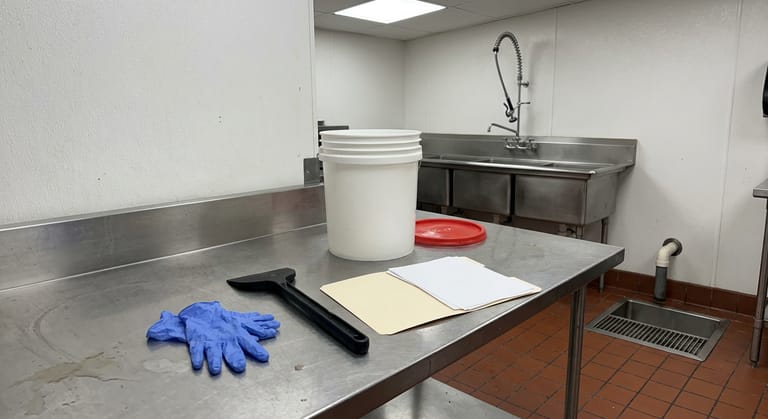
Grease trap cleaning supplies to keep in the kitchen
Four items cover nearly everything a kitchen does for itself.
| Item | What it is for |
|---|---|
| Nitrile gloves | Handling a basket, lid or collection container without skin contact |
| Long-handled scraper | Moving hardened FOG off a small unit's basket and lid at arm's length |
| Lidded bucket | Carrying scraped material, lid on, to the disposal route your sewer program approves, never a drain |
| Service file | Holding manifests, receipts and reports where an inspector can see them |
The fourth item earns its place because a sewer program checks paperwork, not memory. In Portland the duty to "file a cleaning report with the City" sits with the business, not the hauler, and it attaches to each interceptor cleaning or pump out.
If the fixture is a point-of-use unit under the sink, the routine is daily and small. Thermaco's instructions for its Big Dipper automatic grease removal unit say the clear plastic grease and oils collection container beside the unit is to be emptied before it becomes full, once each day.
Talk to someone who opens these lids every week
Call (800) 555-0184Free to dial. Whoever answers pumps and services grease interceptors; ask for the registration number your city requires while you are on the call.Partner haulers and plumbers who work on food service drains- Partners who pump interceptors, not just unclog sinks
- Answered during the dinner rush
- Dialing costs nothing and books nothing
What cleaning chemicals do inside a grease trap
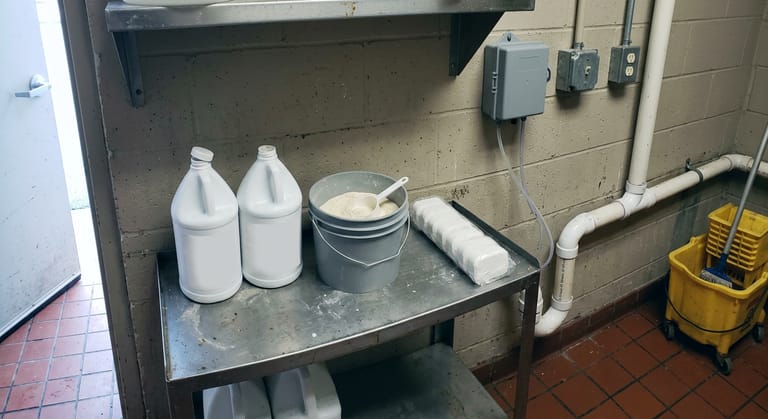
They change how FOG behaves, which is not the same as removing it. Portland, Oregon's Bureau of Environmental Services takes the three product families in turn and arrives at the same place with each.
Emulsifiers break the cap into droplets that travel. On cleaners, solvents, caustics and other chemical emulsifiers, the Bureau's finding is that they "do not eliminate FOG": the tank reads cleaner at the lid while that grease sets up again downstream.
Enzyme products, animal-sourced or synthetic, get a narrower finding. They "temporarily change the physical properties of FOG", a statement about texture, not about gallons removed.
Bacteria fail more plainly. Live cultures "need a more reliably constant environment than a grease interceptor to thrive", and a kitchen trap is the opposite of steady: dish water at one temperature, a fryer dump at another, pH moving with every cleaner poured down the sink.
Portland settles it by rule anyway: Administrative Rule ENB-4.26 prohibits additives regardless of composition.
The concern is where the FOG goes once it moves. Gallup, New Mexico's code at 8-5-7 is reported to define those additives as materials that let grease pass into the collection system.
| City program | What it says about additives |
|---|---|
| Portland, OR (Rule ENB-4.26) | Prohibits additives in grease interceptors regardless of their composition |
| Phoenix, AZ (City Code 28-15) | Reported to prohibit chemicals, enzymes, proteins, bacteria, grease solvents or emulsifiers used to dissolve FOG in lieu of physical cleaning |
| Gallup, NM (section 8-5-7) | Reported to bar any surfactant, solvent or emulsifier, including enzymes, soap, diesel, kerosene and terpene |
| Snohomish, WA (SMC 15.08.140) | Reported to prohibit additives such as enzymes, chemicals or bacteria as a substitute for a required trap or interceptor, unless the City allows it in writing |
Tablets, powders, drip units and liquid dosing solutions land in the same category, and dosing does not move the schedule. Portland's routine cleaning requirement is written around stopping grease buildup from degrading how the interceptor works, so a product that leaves the grease in the tank buys no extra time.
Should you buy a cleaning machine for a grease trap?
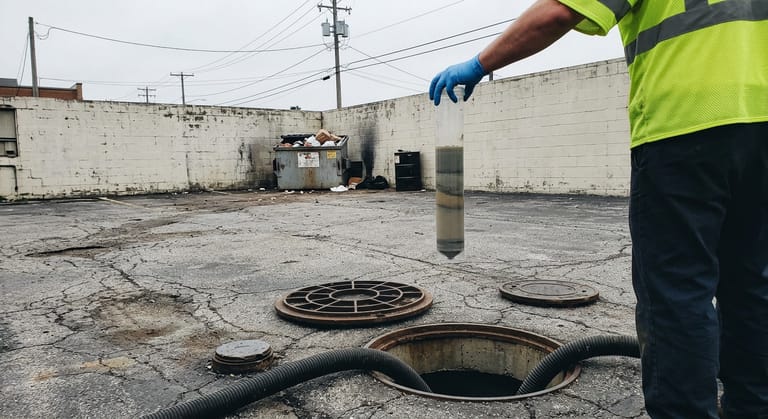
For an in-ground unit, no. Nothing sold to a kitchen handles the two hard parts: moving hundreds of gallons of loaded water, and putting it somewhere legal. What a full pump-out involves covers the rest.
The automatic unit above is the exception, and it is a capture device with a daily chore attached, not a replacement for service. A shop vacuum is the common mistake: it leaves you holding regulated waste that cannot go down any drain.
Which grease trap cleaning tools are worth owning
The grease trap cleaning tools worth owning cost less than a single pump-out, and choosing between a kit and a call takes about two minutes.
- Find the last service paperwork: date cleaned, volume removed, disposal location.
- Identify the fixture. A unit under a sink is operator territory, a tank in the lot is not.
- Ask the city program what report is due, and whether additives are allowed at all.
The work stops being yours at an in-ground interceptor, a unit nobody has opened in a year, a line that backs up right after a service, or a city notice with a date on it. That is a hauler's truck, and when the plumbing itself is at fault, a plumber's job. Ask the dispatcher for the price by tank volume and whether they file the report your city wants.
Talk to someone who opens these lids every week
Call (800) 555-0184Free to dial. Whoever answers pumps and services grease interceptors; ask for the registration number your city requires while you are on the call.Partner haulers and plumbers who work on food service drains- Partners who pump interceptors, not just unclog sinks
- Answered during the dinner rush
- Dialing costs nothing and books nothing